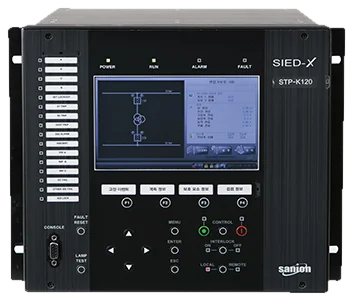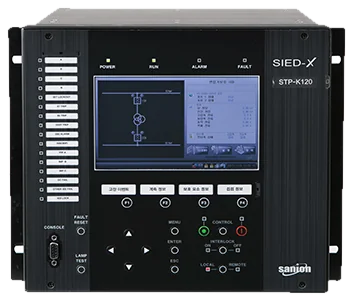
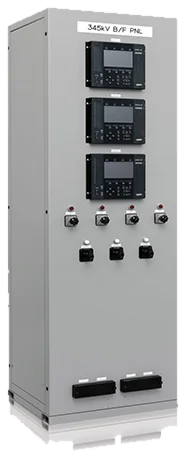
Breaker Failure Protection Panel
A circuit breaker is an electrical switch designed to prevent power system facilities from being damaged by fault current. It plays a major role in protection of the electrical power system facilities. In summary, the corresponding IED detects the fault and generate a trip signal when a fault occurs in power system facilities such as a transmission line or a transformer. At this time, it is a circuit breaker which receives the trip signal from the IED and actually disconnects the faulted facility from the entire power system. However, a mechanical failure may occur at any time since a circuit breaker is a mechanical equipment. In the case of such failure, the circuit breaker cannot execute proper operations such as opening and closing. If the such failed breaker could not disconnect a faulted power equipment from the entire grid system, the fault current would be spread to the surrounding equipment and lead to a serious situation. Thus, it is necessary to have protection panels that can detect the failures of circuit breakers and send the trip signal to all the circuit breakers required to prevent the power system fault from spreading over the surrounding normal power system facilities. Such protection panels are called circuit breaker failure protection panels. 345kV circuit breaker failure protection panel is embedded with three independent IEDs, one for each circuit breaker in the 1.5 CBtype busbar. When overcurrent continues to exist even with a trip signal generated by a protection IED, circuit breaker failure protection IED determines that some circuit breaker has failed and trips the corresponding circuit breaker.
Main functions
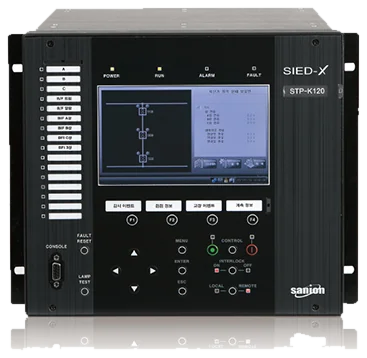
- 2-staged overcurrent detection for each phase
- Receive the phase-segregated or three-phase trip signals from external protection IEDs through digital input channels
- Operating timer setting
- Self-monitoring on a regular basis
Specification
| Division | Item | Specification |
|---|---|---|
| Rated | Input power | DC 90~140[V],60Hz |
| Rated voltage(PT) | 110/√3[V] | |
| Rated current(CT) | 5[A] | |
| Digital output | 10[A] : 250VAC 28 points | |
| Digital input | DC 70 ~ 150[V] 24 points | |
| Communication | Communication port | RS-232, Ethernet, Fiber Optic |
| Protocol | IEC61850, TCP/IP | |
| Time | IRIG-B, SNTP |