Transmission Line Protection Panel
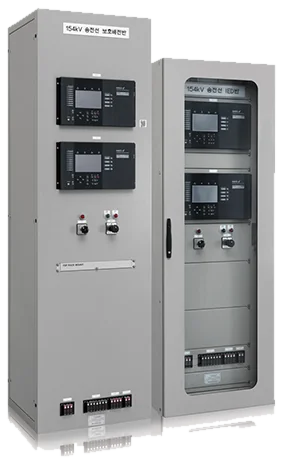
Transmission lines are the power grid facilities that carry electricity from generators to consumers, typically connecting substations. Because they span dozens of kilometers, they are exposed to the natural environment and vulnerable to faults caused by rain, wind and lightning, so faults occur on transmission lines more frequently than on other facilities. A reliable protection scheme is essential, since transmission lines not only deliver electricity but also strongly affect power system stability through changes in power flow when a fault occurs. One IED is applied as the main protection relay, with a function designed to protect the target line section, and a separate IED provides backup protection with a different function covering a wider series of lines.
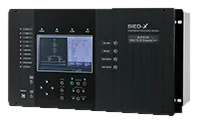
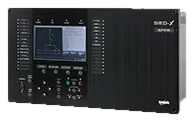
Transmission line Protection Panel
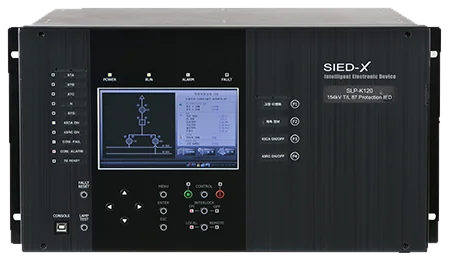
- An 154kV transmission line protection panel has a primary protection IED with PCM communication based current differential protection method (87L) and a secondary protection IED having 3-staged distance based protection method (21G, 21S). In addition, high-speed reclosing function (79) is activated in the primary protection IED.
Short-distance transmission line Protection Panel
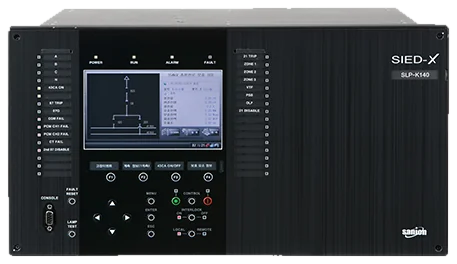
- Transmission lines in urban areas are installed underground by their nature. Thus, their length should be short. Since impedance-based distance protection scheme is not able to provide enough reliability for short distance transmission lines, the secondary protection for such short distance transmission lines tends to adapt both distance protection and the current differential protection. In summary, an 154kV short distance transmission line protection panel applies PCM communication based current differential protection method (87L) as primary protection and combination of 87L and 3-staged distance method (21G, 21S) as secondary protection. Like the case of 154kV transmission line protection panel, high-speed reclosing function (79) is activated in the primary protection IED.
Transmission line Protection Panel
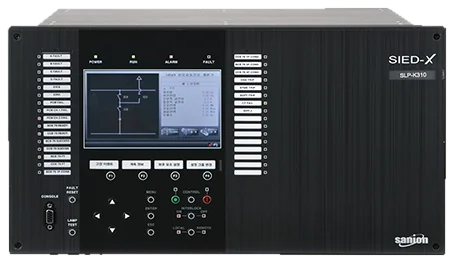
- Primary and secondary protection functions in 345kV transmission line protection panels are basically the same as the ones in 154kV transmission line protection panels. However, taking into account of the characteristics of circuit breakers that are able to trip by phases, the IEDs provide single-phase trip or 3-phase trip function depending on the type of faults. Since 345kV transmission line have a priority over 154kV transmission line, two identical panels are installed redundantly to provide reliability in protection. Like the case in 154kV transmission line protection panels, high-speed reclosing functions (79) are individually embedded in each of two primary protection IEDs with one of them activated according to the operation condition of the substation.
Specification
| Division | Item | SLP-K120 | SLP-K140 | SLP-K310 |
|---|---|---|---|---|
| Ratings | Input power | DC 90~140[V],60Hz | DC 90~140[V],60Hz | DC 90~140[V],60Hz |
| Rated voltage(PT) | 110/√3[V] | 110/√3[V] | 115/√3[V] | |
| Rated current(CT) | 5[A] | 5[A] | 5[A] | |
| Digital output | 10[A] : 250VAC 24 points | 10[A] : 250VAC 32 points | 10[A] : 250VAC 48 points | |
| Digital input | DC 70 ~ 150[V] 40 points | DC 70 ~ 150[V] 36 points | DC 70 ~ 150[V] 24 points | |
| Communication | Communication port | USB B-Type, Ethernet, Fiber Optic | RS-232, Ethernet, Fiber Optic | RS-232, Ethernet, Fiber Optic |
| Protocol | IEC61850, TCP/IP, IEEE C37.94 | IEC61850, TCP/IP, IEEE C37.94 | TCP/IP, IEEE C37.94 | |
| Time | IRIG-B, SNTP | IRIG-B, SNTP | IRIG-B, SNTP |
Main functions
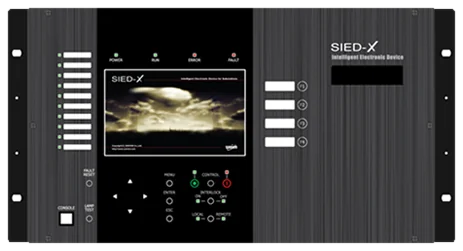
- Phase-segregated current differential protection (87L)
- Highly sensitive zero-sequence current differential protection for high-impedance ground faults (87G)
- Undervoltage and overcurrent based fault detection (UV/UVS/UVD, OC/OCD/OCG, OVG)
- High-speed one time auto-reclosing (79) (SLP-K310: single and 3-phase trip and reclosing)
- Transmission of trip information to opposite end to prevent single-end tripping
- Direct transfer trip (DTT) for circuit breaker failures (SLP-K310)
- Compensation for line charging current
- STUB and SOTF protection trip (SLP-K310)
- Out-of-step protection trip (SLP-K310)
- CT and PT failure detection
- External fault detection to prevent wrong tripping due to CT saturation
- Automated compensation for different CT ratios at both transmission line ends
- High-speed long-distance peer-to-peer communication between two IEDs based on IEEE C37.94 protocol
- Redundant communication lines for improved communication reliability
- Fully IEC 61850 compliant, Edition 1
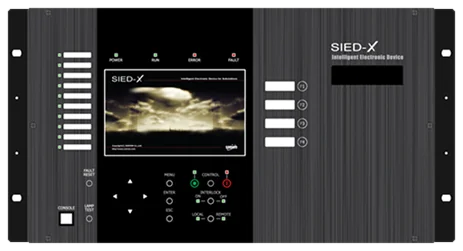
- 3-staged (zone) distance protection (21) based on quadrilateral characteristics (SLP-K310: zone 4 applied for detecting faults on the overhead or underground portion of the line)
- Overcurrent based fault detection (OC/OCD/OCG)
- Undervoltage based fault detection (UV/UVS/UVD) (SLP-K310)
- Zero-sequence current compensation for zone 1&2 and zone 3 respectively
- Prevention of wrong tripping due to heavy load or overreach
- Power swing detection and zone 1/2/3 trip blocking
- Out-of-step protection trip (SLP-K310)
- STUB and SOTF protection trip (SLP-K310)
- Open line fault detection by detecting negative-sequence current and zero-sequence voltage
- PT failure detection, CT failure detection (SLP-K310)
- Fully IEC 61850 compliant, Edition 1