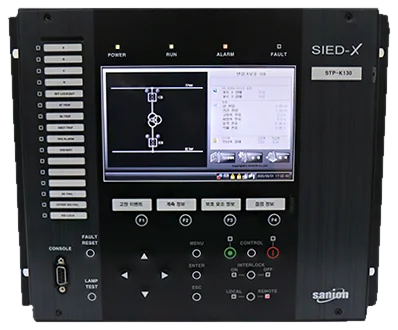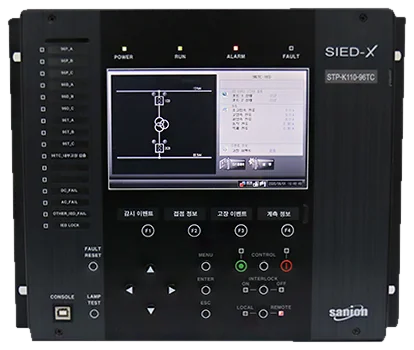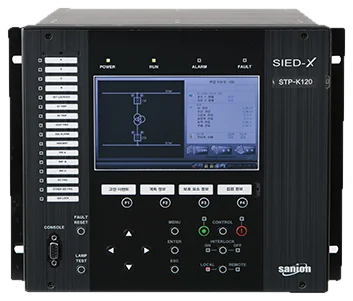
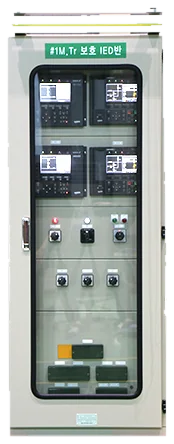
Transformer Protection Panel
Electricity produced by generators is supplied to consumers through electrical power system facilities. During the process, transmission efficiency is very important as it is directly related to the economic feasibility. In order to increase the transmission efficiency, the voltage of the electric power produced by the generators is stepped up to the transmission level. During the transmission process, the voltage of the electric power is stepped down to the distribution level and finally supplied to the electricity consumers. Such voltage step-up and step-down processes are performed through power transformers. Thus, a power transformer is an important facility that greatly affects the efficiency and the stability of the power transmission. In addition, power transformers are very expensive facilities requiring a considerable amount of cost and time to repair critical failures. Therefore, power transformers require protection functions with high speed and excellent reliability. Since a power transformer in the normal condition provides the same capacity at both primary and secondary sides, the current ratio differential protection based on this principle is used as the main protection. The overcurrent function is used as the backup protection for the primary and secondary sides of the transformer, respectively. When a Neutral Grounding Reactor (NGR) is applied to the secondary side of a transformer to limit the external ground fault current, zero-sequence overvoltage protection function is applied to protect the NGR.
Main functions
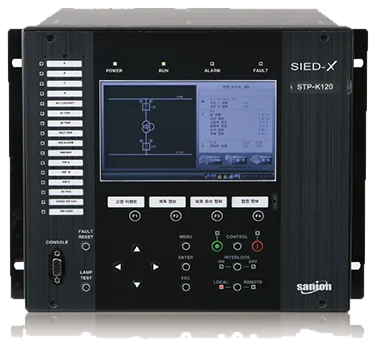
- Protection for 2-winding transformer
- Selection of the protected transformer and CT wiring types
- Primary current set (5 channels) and secondary current set (5 channels) available (STP-K110)
- Primary current set (4 channels), secondary current set (4 channels) and 4 voltage channels available (STP-K120)
- Phase-segregated high-speed current differential protection (87HOC)
- Phase-segregated current ratio differential protection (87R)
- Prevention of wrong tripping due to inrush current
- In comparison with the magnitude of the fundamental frequency component, the current is judged
as inrush current when the magnitude of the second harmonic component is bigger than the preset ratio
- In case of inrush current, mode selection of trip blocking among phase-segregated trip blocking, one-phase trip blocking and two-or-more-phase trip blocking
- Instantaneous, definite-time, and inverse-time phase overcurrent protection and zero-sequence overcurrent protection for each phase of each current set
- Phase overvoltage protection and zero-sequence overvoltage protection (STP-K120)
- Fully IEC 61850 compliant, Edition 1
Specification
| Division | Item | STP-K120 | STP-K130 | STP-K110-96TC |
|---|---|---|---|---|
| Rated | Input power | DC 90~140V[V],60Hz | DC 125V(90~140V) | DC 125V(90~140V) |
| Rated voltage(PT) | 110/√3[V] | 110/√3[V] | - | |
| Rated current(CT) | 5[A] | 5[A] | 5[A] | |
| Digital output | DC 70~150[V] : 24 points | 24 points | 36 points | |
| Digital input | 10[A]:250VAC : 28 points | 28 points | 20 points | |
| Communication | Communication port | RS-232, Ethernet, Fiber Optic | 100Base-FX, 100Base-T, Twisted-pair | 100Base-T, USB B-Type, Twisted-pair |
| Protocol | IEC61850, TCP/IP | IEC61850, TCP/IP | TCP/IP | |
| Time | IRIG-B | IRIG-B | IRIG-B |